Wednesday, February 13, 2008

Volcano

Call it a boondoggle if you want. I knew that I needed to get out of the compound for the day to do some.. reconnaissance. We had heard reports that our waste recycler was dumping the non-recyclable part of his waste shipments in various ditches along the paved road to Al Mukullah. I figured I better go investigate before things got out of hand. So armed with my trusty armed guard and a driver, I set off in search of windmills.

OK, it was a bit of a BD.

We didn't find any Yemgas garbage dumps, and I'm pretty sure that my companions still have no idea what we were doing out there. They eventually came to understand that we were looking for something, but even if I knew the Arabic words for "large amount of garbage from the construction project" I don't think they would have understood the purpose of our quest. Garbage goes on the ground in this part of the world. Where else would it go? Spending time and resources trying to track down some discarded trash so that it could be picked up and hauled off somewhere else is more than foreign, it's like moving a pawn sideways. I am reminded of the story about an Arab man who visited California. He had fallen in love with a movie star, I think it was Farrah Faucett or someone like that. Anyway, he saw her one day walking on the beach with her dog. He was awestruck: here was this larger-than-life image of a famous, rich, radiantly beautiful woman. But what was it in the plastic bag she was carrying that appeared to be, yes, he was quite certain of it now, it... was... dog poop?? Knights pawn to Bishops pawn.

Anyway, Abdul, Ahmed and I enjoyed the break in the routine, and we got to do some exploring, which was pretty cool. Among the nifty places we found was a volcanic caldera, which was filled with water. I took some photos, but I couldn't capture the unnatural greenish tint of the water. I later learned that the color was from volcanic sulfuric acid.


Saturday, February 2, 2008

Random photos

The winter weather in south coastal Yemen is just about ideal: cool nights and very pleasant daytime temperatures. Only one problem: occasional windstorms in the "empty quarter" up north stir up the desert dust which diffuses its way to us (not blown to us, it has been windless here in Balhaf). The empty quarter is a huge, empty desert occupying about 1/4 of the Saudi peninsula, where the wind has been blowing the sand around for so long that the particle size is like tobacco smoke. It acts like ink if you touch it. And it doesn't settle very fast once it becomes airborne, which is why it eventually diffuses here even in the absence of wind.) We have been shrouded in a haze of this dust for a couple of days (Feb 3, 08). This photo is taken in the still of the morning on an otherwise cloudless day. Dust is a way of life throughout large parts of the Middle East, and it goes a long way towards explaining the popularity of the scarf thing that people wrap around their heads. At the first hint of dust conditions, the Yemeni men cover their face with them like a surgical mask. They don't even think about it; it is a reflex. Of course, the women are perpetually prepared for a dust storm.

I spent one day doing an environmental baseline assessment of this beach to determine whether it can be safely used as a recreational outlet on Friday afternoons for 10,000 recreation-deprived workers. The beach is in the next cove east of the construction site. Nobody owns it, nobody goes there, it is a hundred miles from nowhere. My job was to evaluate the potential vulnerability of the coral and to determine whether there were any nesting turtles who may object to human encroachment. In the background is a volcanic island, one of hundreds along the coast. It is safe to guess that no human has ever been on it. Pretty inhospitable basalt boulders, why would anyone want to go there. Still you don't normally think that there are desolate places like this outside of the Antarctic.


Wild (ferrel?) camels are common sights while driving around the countryside. Nobody really owns them as far as I can tell. Apparently they are easily rounded up when someone needs a pack animal, then they are let loose again.


Photo of Balhaf Harbor. By the end of 2008 there will be a long pier completed which will allow deep draft ocean vessels to dock and load product.

Saturday, January 26, 2008

nationalities personalities

I am in Yemen, thousands of miles from the nearest political correctician, so I get to offer some observations about some of the nationalities that are here, with a disclaimer that these generalizations are based on non-representative cross sections. Everyone knows that all generalizations are incorrect.

Still, there may be something to this notion of a national personality; I kinof think there is. Mostly though, these musings hit on my American funny bone.

Americans: There are only 12 of us, engineers for the most part. Fairly predictable demographic: mostly ex-military, most have spent time in Iraq. Mostly white, although there are a couple of black guys - managers like everyone else, well paid. There is a color blindness here in Asia, and I doubt that the 7,000 Arab Muslim laborers notice that these guys are black so much as they notice the Yemgas shirt which identifies them as ex-pats, which means they're about to be told to do something. As far as acceptance by peers, performance expectations, assignment of accomodations, etc. the racial issue is irrelevant. If the Sharia zealots decide to revolt, the black guys will be subject to scimitar death just like everyone else.

Brits: Except for the lowest levels of Yemeni, Turkish and N. Korean labor, the Brits and Americans are the only monolinguists on this project. Everyone else speaks at least two languages. The reason for this is fairly simple: English is the world language. There isn't really as much need to learn an additional language. If you are French and live in France, which is the size of Oregon, you will eventually want to explore new countries. You may want to learn Dutch so you can visit Amsterdam, but your Dutch would be lame, and everyone would respond to you in English anyway. So if you are French, you learn English, and then condescend on Brits and Americans for not being bilingual.

French: Safe to say that most of the career oil industry folks on this project are politically conservative, but even the most conservative Frenchman on this project is well to the left of the moderate American Republican. It would be nice if the French would adopt George Bush like that zany nincompoop Jerry Lewis, but helas, the overwhelming consensus is "E is stupeed, non?" It would be trite to go into the French stereotype; suffice it that there is a kernal of truth to it. I will cite an example of what may be quintessential french, but may be just a simple case of aro/ignorance: The senior managers on this project are French. There is a level of disorganization from the top which affects everyone on this project. For mid-managers, it manifests itself in the way that they plug into ones' projects - supplementing, countermanding, rejecting, whatever - without bothering to tell the task manager. Example: yesterday there was an epileptic seizure in one of the camps, and when the Yemgas doctor showed up and called the ambulance he was informed that the ambulance contract had been cancelled by the Resident Construction Manager as a cost control measure. As a sidenote: the non-euro mid-managers are treated worse in this regard than euros. It is fairly clear that the French managers have retained a residuum of colonial attitude that shows up in their interactions with non-euros. It is not blatant, but in this theater, devoid external distractions, it is hard not to notice. I hasten to add that this foible is only evident in a select few senior managers. In fact, I tend to associate with the French engineers more than others, even Americans - partially so that I can practive speaking French. Every so occasionally, someone will come up with some bourbon and a few of us will hold talks in a private setting away from the milleu. It's fun to flop between English and French during these moments of detente (c'est a dire: relaxation).

Yemenis: Felix Arab is what the Romans called them - friendly arabs. And they are. Somewhat innocent, really. They are only a generation or so removed from the 14th century. It's fun to observe the learning curve. For example, they still coming to grips with cell phones; there is some posturing when they get a call in a public setting. Also, Arabic does not have a "P" sound; they pronounce "p" as "b." One of my employees is forever informing me that the bump went out. It's like he has a permanent cold. I taught him about Peter Piper, and force him to recite it occasionally - for his benefit, really. There's probably some Muslim stricture against the "p" sound and I'm scarring him for life.

Other Arabs: I have access to a spreadhseet that is updated weekly, which breaks down the nationalities represented on the project. Surprisingly, there are very few other Middle Eastern nationalities represented. There are reasons for this. The Saudis don't need work in Yemen; they have plenty going on back home. Plus I think there is a bit of a condensention thing going on with Yemen's big brother. Some of the other Arab nationalities, for example, Iran, are not allowed because they are Shite. One of the larger Subcontractors - PetroJet - is Egyptian, with 400 employees. There is a national pride among the Egyptians that seems to be missing in other Middle Eastern nations. Not hard to imagine why, when you consider most of them were created over cocktails by some Brit with a map and a magic marker. This detail was lost on Mr. Bush, who thought he could coalesce a nation into a single identity with a shared vision. "E plurabis unim" tatoos would appear in the tonier cafes. Olympic dogsled team. National anthem. A flag.

Lebanese: Essentailly a southern European country as far as I can tell. There are a fair number of Lebanese within Yemgas and among the Subcontractors. Most of them are exceptionally cool. Like the Egyptians, all of them speak glowingly of their country, and seem to accept the political strife as a way of life. One of the hipper guys is Palestianian - he may as well be from LA. He hangs out mostly with a Maronite (Christian) guy and they get along well, although they rib each other ruthlessly for the entertainment of the Euros. If you talk to them separately, you find that their opinions on the hot button issues are polar opposites, for examples the influence of Syria, the ethics of Hezbollah, etc. But it doesn't affect their friendship. They enjoy bourbon, and seem to have access to a supply train.

Indians: Face it; they are square by western standards. Mirth is not part of their makeup. Penchant for bad glasses; like the Koreans, but with the Koreans you get the idea that they aren't hip because they don't want to draw attention to themselves as they quietly learn, accumulate, prepare... The Indians just don't care. Most of them speak a hundred languages, including English. But their English can be a challenge to understand, as their consonant projection comes from somewhere around their back molars. They love to end sentences with "only." Like "They will do what their supervisors say only." Generally speaking, they are competent and quiet. There seems to be an inner peace that they are not interested in explaining unless you press them, and even then you can't quite figure out what makes them tick. Anyway, the Indians are worse drivers than the Yemenis. Neither of them understand driving concepts that are second nature in the west. For example, they will drive up close behind a stopped car that obviously is going to need to back up. The Yemenis don't yield right of way to pedestrians, but the Indians apply a caste system approach whereby an Ex Pat pedestrian is yielded right of way, but a laborer knows better than to walk in front of a Hindu driver. It's a toss up when an Ex-pat and Laborer are walking together. The same curious phenomenon occurs with Indians and Pakistanis as with the Maronite and Palestinian. They hang out together. My theory - I have to have a theory - is that living and working in this environment is kindof a mutual adversary, which is more real than the blood struggle that goes on back home. I'm pretty convinced that Patel and Abdula won't be exchanging Christmas cards once the project is over, but at least while they are here, there's an easy familiarity that glues them together.

Friday, January 18, 2008

Balhaf Recreation

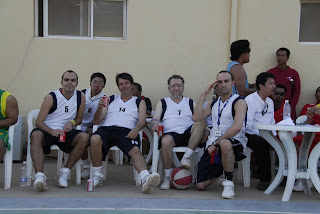
what a motley crew, the Yemgas Globe Trotters. At least the name is accurate. From left to right, we have French, Hong Kong, Austin, College Station and Italian. Not pictured are Venezuelan, Lebanese and a couple more French.
The Yemgas Green team is Yemeni.
The TDD Tankers (they are constructing the cryogenic tanks) are Korean.

Other recreational stuff to do in the very limited off-hours is swim at the beach, jog the perimeter road on the inside of the fenceline. Occasionnally the Euro Ex-pats will organize a Friday afternoon drive to Bir Ali, which is an oasis, literally - you've heard the term, this is really one of them - up the coast to the east. There is nothing there by way of amenities, but the security people have deemed it safe, kindof, and it is an excuse to leave the fenced compound. Actually, as of this writing - Jan 18, 2008 - it is not safe. I have heard rumblings about some kindof of weirdness outside, which has suspended Bir Ali visits for the time being. Didn't pay it much attention, but should have, if only to be more informed-sounding in writing about it. Death was involved, so I'll try to remember to ask the security guys, who work down the hall from me about it. Stay tuned.

Sunday, January 6, 2008

Return to Balhaf for Rotation #2

The most profound impression from my three-week Christmas vacation was its brevity. I’m reminded of the old-timey Hollywood depiction of the passing of time where the calendar pages curl and drop to the ground like falling leaves.

I learned something about myself during the time off: although I didn’t really have many demands on my time, I still managed to fall back into that familiar lifestyle of being rushed. I am perpetually rushing whether in Austin or in Yemen: here rushed, there rushed, everywhere rushed rushed. I’m the old MacDonald of poor time management.

I got back to Balhaf in the early hours of New Year’s Day and stopped by my cabin to unpack suitcases and take a shower before heading into the office. The transition from vacation mode to work came while in the shower, when I noticed that the soap did not rinse very well and I made a mental note to check the CaCO3 metering pumps at the RO plant.

The project remains a fascination for me. There are new and different things every day. The human interest stories are enough to keep me engaged. This afternoon, at management’s insistence, I accompanied security in an investigation of an illicit still that was in operation at the Hawk (a heavy equipment contractor) bakery. They made a wine by fermenting fruit and sugar with bread yeast, then they distilled the resultant ferment using a crude but ingenious still, involving double boilers and ice. The word I got was that the moonshine was respectable, but, unfortunately, they had dumped it by the time I got there. The human interest was the fall guy. Hodji or something, from Bangalore. He was shaking in his boots. It was pretty clear he had been set up as the sacrificial lamb. He told the security guy – Keitel, a stern Lebanese ex-military police - that nobody else knew about the operation, and that he drank all of the product himself. Keitel wanted to implicate management for duplicity, but I kindof cooled him down. It is tough for me to see someone punished for something I would have done, if I has thought of it. I kept Keitel from dragging down the kitchen management, even though it was clear they were partners in crime. But I couldn't do anything for Hodj, who was on the next flight to Bangalore. The problem was that by late afternoon, all 3 thousand mostly Yemenis at Hawk knew that Yemgas knew about the still. The Shariat has a problem with alcohol, and consequently under the circumstances, Yemgas/Hawk had to sacrifice someone in order to avert another uprising.

Sunday, December 2, 2007

Typical Day


I brought a 110 volt alarm clock with me, valueless of course: everything here is 220. Doesn’t matter though. I haven’t needed one. I get to sleep most nights by 9 pm, and I wake up around 5:15. Maybe 2 nights per week I get to sleep by 8, which means I wake up to the 4 AM edition of the muezzin as they call the faithful to prayer in the Pioneer Camp mosques. This ancient tradition was pretty otherworldly the first few times I heard it, especially just coming out of a sound sleep. The Koranic verses are sung all wobbly-voiced like in the movies. This first of five adhans of the day is an alarm clock for about 5 thousand Muslims on this project. The Hawk (Yemeni civil engineering company) camp and the PetroJet (Egyptian pressure vessel firm) are near enough that I can now recognize one from the other. It is actually pretty cool to lie and listen to ululating muezzins in the still of the early morning air before the construction noise begins.

I shower, dress and head to breakfast at the European canteen. The food is fair, a French firm runs the kitchen. Fruit, granola, yogurt, croissants. They try to do hot stuff, but it is awful. Hot dogs in lieu of sausage. Macaroni and ham with béchamel sauce. (the European canteen gets ham and bacon, but it is otherwise pretty much forbidden - and unwanted - in the other canteens). There is a reason the French stick to Continental breakfast.

Typically I meet one of my direct reports after breakfast and we drive to the office about a mile away from the camps. There are two Toyota trucks to use among my four-person team, and it works out pretty well.

I am the ranking environmental engineer on this project. I have two HVEs and two Yemenis that work directly for me, and each of the 14 Subcontractors have environmental staff that more or less report to me.

The major responsibilities assigned to me are: keeping the corals alive; oversight of a marginally performing, extended aeration sewer treatment plant; waste management via a combination of incineration and off-site recycling; oversight of the Reverse Osmosis units (ie, potable water). Other assigned areas of responsibility include camp and work place inspections. This includes hygiene inspections of the Subcontractor dining halls, kitchens, billets, ablutions. No, these are not terms I used much in Austin. Ablutions are places to wash up before going to bang one’s head on the ground in deference to the higher being.

In this connection I have to make a sidebar comment – some of the Muslims wear their religion on their sleeve, so to speak. Actually they wear it on their forehead – these guys favor asphalt for prayer, and they clang their heads on the pavement hard enough that it develops a blackened callous. You can see these guys walking around with blackened circles on their foreheads. Lots of the Egyptians do this, but I’m not sure it is restricted to them.

Anyway, a typical day for me is today – Nov 28, 2007. I started the day resolving an argument between a Subcontractor camp boss and my Yemeni inspector, who had given him a low score on a kitchen inspection. The kitchen inspections are pretty important – the word I get from our Yemgas doctor is that a salmonella outbreak would suspend the project for several weeks. Anyway, a low score on a kitchen inspection is serious business for a HVE camp manager, in this case a Turk, who looks at his relatively high salary as a godsend, not to be trifled with, especially by a Yemeni inspector.

Dispute resolved, I wrote up a couple of incident reports, which require a root cause analysis, and corrective actions to be implemented. One involved a tug boat that drove over a silt curtain which protects one of the very sensitive coral reefs (this was Muhibbah, a Malaysian firm). Another incident was Punj Lloyd, an Indian utilities firm, who bulldozed into a concrete septic tank causing the release of 5000 liters of raw sewage, which flowed downhill and pooled in a laydown yard of utility pipes.

I spent most of the afternoon coordinating over long distance with a French firm that is coming onsite next week to provide Marine Large Spill training. They will train some of the shorefront and barge personnel how to contain a large spill using huge oil booms that are towed into place with a tug boat, and oil skimmers that ride over the surface sucking up the petro. The training will actually simulate a spill using a drum of hydraulic oil that will be dumped into the ocean (under controlled conditions, hopefully).

No question this is the most responsible, and most accountable position I have held in my professional career. It has pros and cons, of course. There is absolutely zero QA/QC of the decisions I make, no one has time or expertise to do it. When things go right, it is an exhilarating feeling to see my projects come to fruition. On the other hand, I imagine that bad decisions will result in spectacular flame outs, with little compassion from management. I haven’t seen this yet, and don’t plan to.

Friday, November 23, 2007

Blue Lagoon


I have never seen clearer, bluer water. This is the backside of the facility, which, unfortunately, is about to go under construction of a cooling water outfall structure. Corals are on the far side of the silt curtain, the floats of which can be seen at the interface of the two blue colors. I have made it a matter of personal comittment to protect this area; it really is much prettier than what you can see in the photo. The two shades of blue are awesome. The sand is like sugar.

Arabian Sea Overlook


Me and Khalid. Everyone should have a bodyguard.

The road to Al Mukulla


My protector. None of the expats can travel outside of the compound without an armed guard. This photo was taken during a day trip to Al Mukulla to audit a waste recycler's operations.

Yemeni Grrrirls

This is typical. You don't see many women out and around, but the few that you do see look exactly like this.

This is downtown Mukulla.

Seashore between Balhaf and Al Mukulla


This is a very typical view of the south coast of Yemen (except for the white guy in the foreground). Mostly sandy beaches with turquoise water. The air quality here is quite good - certainly there is no manmade air pollution. But all of the features in the distance - mountains, islands, etc - all have a mirageish appearance. The island in the background looks in real life just like it appears in this photo, as if looking through a filter.

Sunday, November 18, 2007

Eid al Fitr (End of Ramadan)

I arrived at Balhaf on October 13, just after Ramadan. The Muslim population, about 75% of the labor force, was in recovery mode following a month of fasting and white-knuckled spirituality. As a consequence, nothing much was accomplished by way of my in-processing, setting up a place to work or computer access during the 3 days of feast and festivity of the Eid al Fitr. The Yemgas management goes out of its way to accommodate the religious needs of the Muslims, in part because the Yemeni government, a 20% owner, requires it. But also because the uneducated Muslims - which is to say most of them - are already a bit freaked out about working for the infidels.

There are makeshift mosques that Yemgas has set up all over the plant, consisting of simple concrete block rooms, facing Mecca of course, which is about 400 miles to the north. The mosques all have an associated ablution hut, equipped with toilets and sinks for washing up in preparation for prayer. They heed the muezzins’ calls to prayer five times daily, two or three of which are during work hours. It takes a block of time out of the day, but they are fully compensated. The subcontractors do their best to downplay these work absences to the Chinese, Korean and Indian laborers, who don’t get these breaks, but of course it is impossible for them not to notice.

Yemen is among the most regressive of all the Muslim countries: they rank high in the usual categories – tribal mentality, xenophobia, repression of education and women, melding of church and state. The Yemenis have earned a reputation as reactionary, true believers. The USS Cole was bombed at Aden, about 300 km down the beach. The 9-11 hijackers were well represented by Yemeni zealots. The bin Laden clan has their ancestral roots here, and the family construction business has its way with government contracts for infrastructure, at least in areas where the concept of infrastructure has meaning.

The Governorate of Sabwa, where Balhaf is located, is populated very sparsely by tribal groups. There have been several strikes in these parts against western targets in the recent past, although, in some cases it is less an aggression against the west than it is against the local and national government. Yesterday there was a pipeline explosion in Marib, north of here, brought about by tribesmen who are known to be discontented with the level of spending the provincial government dedicates to infrastructure improvements. This is fairly common in the backwater areas, where tribal government competes with conventional government as the dominant political presence. In order to force spending on public works, they blow something up, or, more successfully, they kidnap a westerner and the government pays a ransom for their release (the Yemen government is keen to minimize bad press in order to encourage foreign investment in projects like YLNG.) The tribes have found that this approach can work: in several cases the ransom money has been used to pay for roads and schools.

On March 26, 2007, there was a riot at YLNG. The word got out to the labor force that one of the managers had desecrated a Koran, by touching it, or throwing on the floor – we will never know the true story. With each retelling of the story in the workplace, the description of the desecration got worse. Thus incensed, an angry mob formed. They moved to the fire station and disabled the fire truck, then moved on to the heli pad and doused the helicopter with diesel and set it on fire. YLNG ordered the charter plane to take off rather than risk the torch. The prevailing belief is that the protest was orchestrated and the story about the Koran desecration was contrived. 50 or so Yemenis were arrested and they ultimately disappeared from the project. The mob, apparently satisfied that their message had been heard, cooled off and went back to work.
My opinion about the security conditions has evolved during the four weeks that I have been here. Initially, the only information available to me was the intimidatingly heavy fences and concertina wire strung everywhere inside and outside the facility, and the omnipresent Yemini military, with checkpoints at gate entrances and even at cafeterias. There are jeeps with turret-mounted machine guns constantly circling the perimeter of the fence. But over time, I have grown to realize that the Yemini laborers are mostly just interested in job security; there is an incentive for individuals to keep the management happy because there will be a significant manpower requirement to operate the plant once the construction is finished. I have never seen anything remotely resembling resentment, quite the contrary, I am treated with deference and respect anywhere I go. I have no trepidations whatsoever wandering among the so-called pioneer camps, even after dark. I have two Yemenis on my staff: they are career-minded and eager to learn so that they will have skills to offer once the hiring of long-term employees begins. It is difficult for me to imagine that either Ghamal or Hussein would participate in a riot targeting western personnel or materials. Still, it is a bit disconcerting that the March riot sought out the weak link in the YLNG security system: our means of escape.

Balhaf


Imagine a place so remote and uninviting that land ownership or property boundaries are irrelevant, the terrain so unnuturing that there are no ants, weeds, cactus or indigenous life of any kind. To the north, as far as the eye can see there is nothing but the tan and brown of sand dunes and volcanic ruble; to the south, the unbroken blue horizon of the Arabian Sea.

The project site – Yemen Liquified Natural Gas - shares a peninsula with an extinct volcanic outcrop, which is readily seen in a Google Maps search of Balhaf, Yemen. The other key feature evident in the satellite image is the crystal clarity of the water: the coral reef which surrounds the peninsula is clearly visible from space. The fenced portion of the facility extends several kilometers from the coast into climbing terrain of endless nothingness.
In contrast with the emptiness of the landscape beyond the fence, YLNG is a thriving city. As of this writing, there are 7,700 residents – all men - working 10 – 12 hours/day, 7 days/week. By the end of 2007 the number will grow to 10,000. There are 30 subcontractors from 20 different countries. The senior management of Yemgas, the prime contractor, consists of about 50 Europeans, mostly French and Brit, along with about 12 Americans, including me. Several of the specialty subcontractor firms – catering, utility management, commercial diving - are European and the managers of these firms, maybe 30 all told, are Euros. There are about 30 owner reps from the French firm, Total, verifying payment draws and monitoring the work progress. And that’s it. The balance of the population is Asian and African: mostly Arab laborers, but there are also large numbers of Chinese, Bangaldeshies, Indians and Koreans. In addition to being all men, there is another common denominator: every one of the inhabitants of this strange community – management and labor alike - are earning more money than they ever have. Another trait in common: not one of us would be here if we weren’t.

Travel Sidebar

When we look back on the menace of communism, it doesn’t seem so menacing anymore. Not long ago, I had an encounter with a drunk frat boy at the Draught House in Austin. He was clearly looking for a fight, so I deferred to his tirading. He inveighed with pointed but wobbly finger that my generation had lost its will in Vietnam, implying, I guess, that he supported an indefinite stay in Iraq.

I didn’t tell him that I had recently been to Vietnam and that it is a stable government with a steadily improving standard of living. The US is Vietnam’s #1 trading partner. Vietnam has emerged as a reliable ally in an otherwise unstable part of the world. In retrospect, it seems silly that we would have been fighting against this eventuality.

I think there were two important lessons that came out of the Cold War:

1.) We confused communism with repressive dictatorship. All of the propaganda against communism portrayed dictatorial and repressive regimes. That’s what we were fighting, not communism.
2.) Also, we learned that setting a good example is the best way to influence world events. The Cold War wasn’t won by the west; the Soviet Bloc imploded on its own. The example set by 1st world democracies influenced the outcome, but it was passive. The people in the Soviet block finally got tired of chronic grayness. They saw an alternative, so they took action.

How do those lessons apply to today’s crises in the Middle East?:

1.) We must be careful not to confuse criminal acts with nationalist or religious warfare. 911 was a criminal act, and should have been prosecuted as such. Our administration framed it as an act of war, and responded accordingly. In doing so they alienated many people who would have otherwise supported a police response.
2.) The only way to neutralize Muslim extremism is to lead by example and allow it to implode on its own. Any attempt by an infidel, especially the US, to win an ideological battle in the Middle East is doomed. The only hope for success is to address episodic eruptions as police actions, and let the court of world opinion take care of the rest. The weapons that these extremists rely upon are inherently self-defeating: restrictions on education and media; repression of women; promotion of an us-against-them credo. It is a concern that 1/6th of the world’s population increasingly condones this closed-mindedness, except that 5/6 think they are a bunch of kooks.

The opinions described above are intolerable to many Americans. They are unaware or unconcerned that during the Bush administration, world opinion has swayed heavily against the US. They seem oblivious to the loss of US hegemony in everything except military power. Much of the rest of the world would love to see US influence diminish; indeed it already has, due to declining clout in the world economy. Our enemies know that they can bankrupt us because the current administration can’t recognize a tar baby when it sees one.

Saturday, November 17, 2007

Travel


The travel to Yemen was long – three days. Luckily, with a little help from my friends, I was able to catch up on the sleep that had been deprived during the days leading to my departure. The 4 hour layover at the Frankfurt Flughavn was a bit of a blur, although I remember enjoying some oversized pilsners at the Goethe Bar. I was pleased to find that my German had stuck with me enough to carry on a casual conversation while keeping an eye on my Lufthansa gate. I was reminded of the million other pilsners and casual conversations I had enjoyed 20 years earlier while defending Europe against the red menace.

The Frankfurt to Sana'a leg was nearly as long as Chicago to Frankfurt, and I passed the time again in a narcotic coma, thank goodness for helpful friends. Based on the orientation sessions and literature provided by KBR, I should have been on my toes upon arrival at Sana’a, the capital of Yemen. Instead I was torporous. Luckily Al Qaeda was off duty, and the visa and customs processing was uneventful. My driver met me outside of customs with my luggage. His face matched the photo I was provided in my security dossier – I love that term, it’s so spy - so I got into his car and drove across town to the Sana’a Sheraton.

The next morning’s flight was in a twin engine charter plane, one of two that is dedicated to the Yemen LNG project. All of the ex-pats on the project – about two hundred – are shuttled from Sana’a in these planes. I was the only American, and the only first timer. The others on my flight were from Egypt, England and France. They were coming off of rotation leave, and they seemed cheerful enough, which I took as a good sign.

The plane took off into the cloudless sky, and headed south. The flight attendant recited the familiar instructions about seat belts and cell phones in both Arabic and English. The city below gave way to isolated mountain villages with sparse patches of green, which I took to be agriculture. Eventually the villages played out and we flew for an hour and a half over barren, sun-baked desert, with no evidence whatsoever of roads, development or commerce of any kind.

Friday, November 16, 2007

Intro

Ships in harbor are safe, but that’s not what ships are for…

It took three full days to travel from Austin to Balhaf, Yemen. I flew out of Austin Bergstrom International Airport on Thursday, October 11 - under a new moon, appropriately – and laidover in Chicago, Frankfurt, Riyadh, and Sana’a, before finally arriving by propeller plane at the project site on Saturday afternoon.

My departure was characteristically unorganized, maybe even more than normal for me, and I left a good bit of important administranea partially or completely incomplete. Although I had been pushing for this ex-pat opportunity for two months, the mobilization date had remained elusive, and only came into sharp focus in the last week before I left. My normally chaotic Austin life had been exceptionally frenetic in the weeks leading up to departure, due to a hurricane of personal, professional and civic preoccupations competing for my time. So I didn’t pay much attention to the million details attendant to relocation to a new job in a foreign country until way late. Suffice it that my last few days in Austin were pretty scattered. I’m sure it will be some time before I realize all the repercussions of things left undone.

Friends and acquaintances’ opinions were split on my decision to take the job. A fair number - most, probably - wondered why I would consider leaving a comfortable life, great job, new house, great friends, a 30-year love affair with Austin, to move to a very remote industrial gulag in a part of the world that made no secret of its disdain for Americans. A smaller number were excited about my traveling to exotic lands, with the promise of adventure, new sights, new sounds.

But it wasn’t the allure of adventure in exotic lands that drove my decision; mostly it was an intangible, but palpable need for a change. In spite of the Edenish life I enjoyed in Austin, centering on fun things - friends, fine dining, the music scene, yacht club, a new house located a short walk from Barton Springs, the lake and downtown Austin - I sensed something missing. I couldn’t put my finger on it exactly. In fact, for some time I had done my best to block it out with sensual distractions and intellectual amusements. But increasingly, these diversions only served to conjure a recurring sense that I was not being creative with my time and that comfy, familiar Austin was a distraction that stood in the way of something, not sure what.

Some people are motivated by ingrained sense of grandeur, which compels them to do creative things with their lives. They are guided by the stars as they meaningfully fulfill their role in a magnificent celestial plan. Not me. Although I value creativity as a personal goal, I typically avoid it except when there is nothing else fun to do. It is only when I have exhausted all avenues of procrastination, when there is no side door to slip through, that I am forced to act upon my innate creative impulses. The opportunity to work for KBR in Yemen provided that for me. No side doors. The timing was right, and I grew to realize that that an irreversible commitment for a year or so as an ex-pat in a remote, extremely unfamiliar and probably uncomfortable corner of the world would force me to recalibrate my life. And in doing so, I would also be able to satisfy a travel bug, maybe shake some bad habits and act on a number of New Year’s resolutions that I had been putting off.